A tea cannot be made from the same plant twice.
The Greek philosopher Heraclitus famously wrote that no man steps into the same river twice. The river flows on, and when the man returns, he is a changed person. Tea, it turns out, behaves in much the same way.
If you drink tea for its sensory pleasures, you are probably familiar with a tea flavour wheel found in tasting guides. To newcomers, it may seem improbable that a single humble leaf can produce such an extraordinary range of flavours: jasmine and stone fruit, seaweed, orchids, spice, cocoa, leather, minerals and wood smoke. A high-mountain oolong tea, for example, grown slowly amid cool mist and cloud, might reveal notes of orchid, cream and fresh alpine forest.
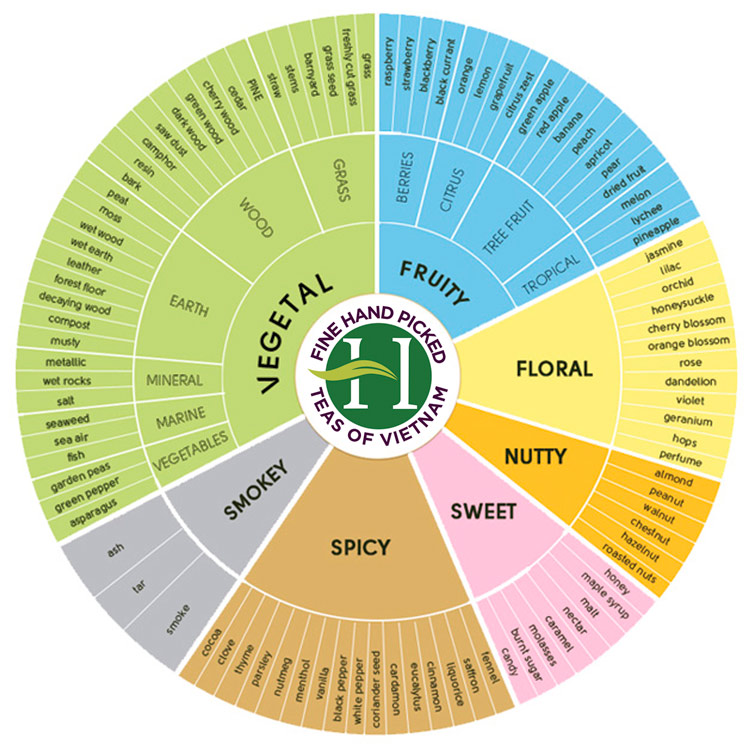
Yet the flavour wheel does not exaggerate. Depending on tea type, an entire spectrum of taste and aroma can emerge. At its best, the same tea can reveal a succession of distinct flavours across multiple brews.
Flavour, however, is only part of the story. What we experience in the cup is the expression of a much deeper chemical process. Add in mouthfeel, texture, aftertaste, and the psychoactive effects of caffeine and theanine, and the sensory permutations of tea are remarkable. And the reason is chemistry.
Tea’s extraordinary flavour complexity comes from no single ingredient. Instead, it is a perfect storm of genetics, environment, and transformation.
Evolving in a humid, pest-heavy environment, the tea plant developed polyphenols, caffeine and aromatic compounds as part of its survival strategy. By chance, the balance of these defensive chemicals falls within a range humans find endlessly appealing. A feat few other leaves have achieved.
Other components of the leaf contribute as well. Amino acids, sugars, lipids, and pigments each play a part in shaping the character of any tea.
While genetics provide the foundation for flavour, they represent one stage of the journey from plant to cup. Tea leaves are also shaped by terroir – the combination of natural conditions and human practices that give agricultural products a sense of place – and processing.
Nature contributes altitude, slope, rainfall, sunshine, mist, soil composition, microbial life and temperature. Human intervention adds plant selection, farming practices, pruning and harvesting schedules. The age of the plants and the depth and breadth of their root systems also play a role.
Every aspect of terroir impacts the pressures and stresses experienced by the plant. Sunlight, wind, soil and water all influence leaf growth and what is stored inside. What we eventually sense as flavour is the plant’s response to its environment. Those small differences in chemistry become expressed as sensory differences and ensure that no harvest is ever quite the same.
Even in a world increasingly dominated by clonally propagated cultivars, two genetically identical plants grown in different environments will never be identical. Different environmental pressures emphasise different genes.
When tea leaves are freshly harvested, they are almost entirely odourless. It is during processing, that the aromatic alchemy begins.
Each processing step manages enzyme activity – denying, encouraging or accelerating it – to convert foundational compounds into hundreds of aromatic molecules. Flavours are preserved, revealed or created according to the style of tea and the skill of the person making it.
Tea leaves also possess another rarely discussed strength: resilience under processing. Where many leaves would simply break down, tea thrives under shaking, bruising, rolling and roasting. Other plants may release pleasant aromas when dried and steeped, but none match tea’s capacity for enzyme-driven transformation.
Think about tea as a film production. Genetics provides the screenplay, establishing the structure of the story. Terroir selects the cast and the landscape in which it unfolds. Processing becomes the editing room, where decisions on timing and emphasis create the finished product.
The tea in your cup becomes the final cut of the film – one version of a story that could have unfolded in so many different ways.
And so, we return to the original proposition: a tea cannot be made from the same plant twice.
Like Heraclitus’s river, everything has moved on. The plant is slightly older, its roots reaching deeper and wider. Climate and soil have fashioned the point in time chemistry of the leaves. Processing choices have guided aromatic expression. And the tea maker’s technique has evolved with experience – and perhaps with mood.
Every tea is ultimately the product of genetics, terroir and processing. It is one that has never existed before and could never be made in quite the same way again.
 Vietnam Tea Blog